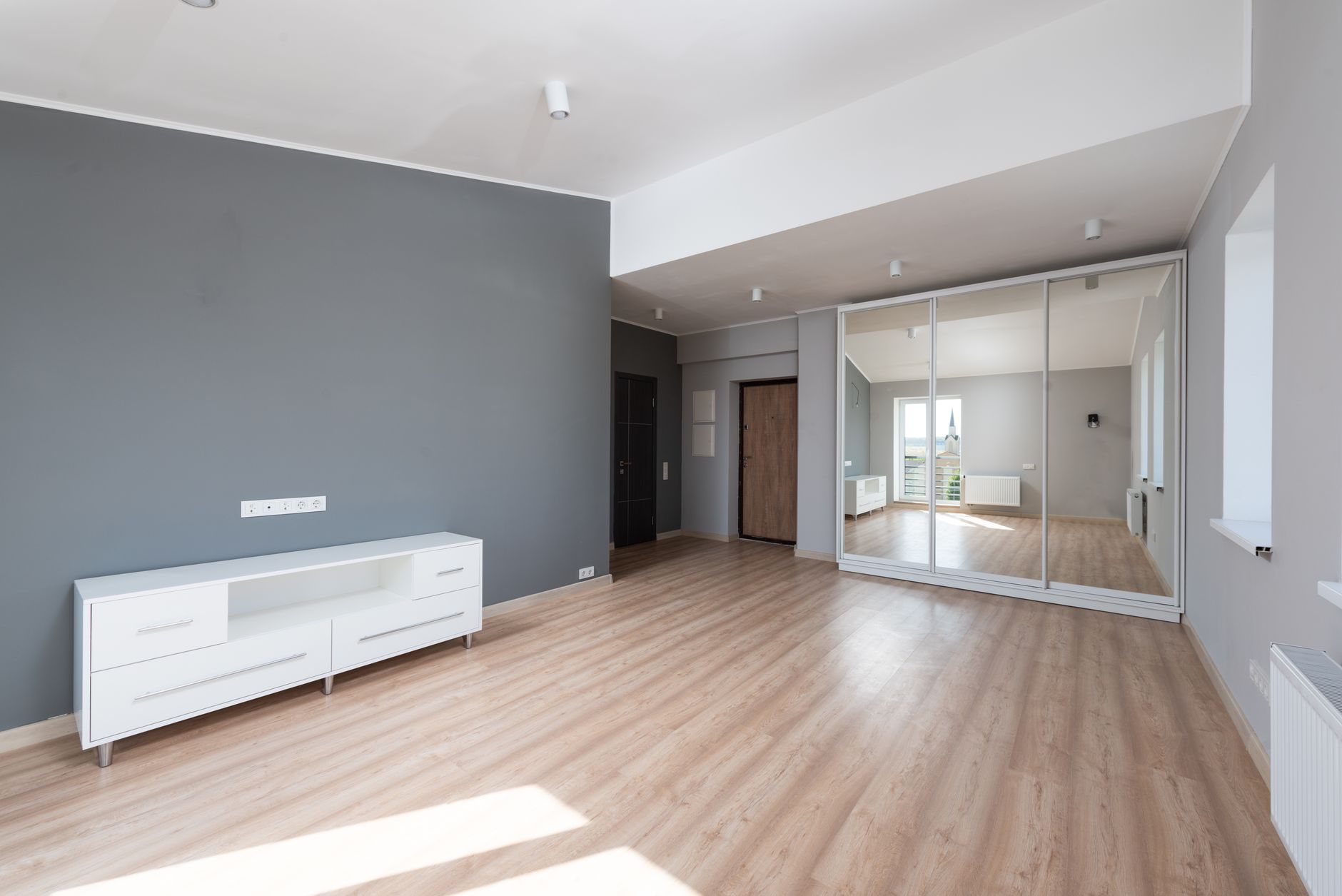
Luxury Vinyl Plank Flooring in Minnesota: Costs, Where It Works, Where It Doesn't
Luxury vinyl plank is the most-installed residential floor in the United States today. In Minnesota it earns that position for a specific reason: it is the only mainstream floor that does not care about a damp basement.
Why LVP took over Minnesota basements
A great many Minnesota houses have a basement or a lower level that is partly below grade,
and below-grade concrete moves moisture upward whether or not there has ever been standing water
in the room. That single fact rules out solid hardwood outright and makes laminate a gamble,
because both are wood products and both swell when the vapor finds them.
Rigid-core luxury vinyl plank is not a wood product. It will sit on a below-grade slab, tolerate
a burst washing machine hose, and be dried and kept rather than cut out and thrown away. In a state
where the median home was built in 1965 and a quarter of the housing stock predates 1940, “can this
floor survive being wet once” is not a hypothetical question.
The two grades, and why the cheap one disappoints
Almost everything sold as LVP falls into one of two constructions, and the difference matters
more than the color does:
- SPC (stone-plastic composite) — a dense mineral core. Rigid, dimensionally
stable, forgiving of a subfloor that is not perfectly flat, and noticeably harder underfoot. This is
the one that belongs on a basement slab. - WPC (wood-plastic composite) — a lighter foamed core. Warmer and quieter to
walk on, but softer, so heavy furniture legs dent it and it telegraphs an uneven subfloor.
Below either of those sits a large category of thin flexible glue-down and click vinyl that is
genuinely a different product. It will follow every ridge in an old plank subfloor, and the wear
layer is where the manufacturer saves money. If you are comparing quotes and one is dramatically
cheaper, the wear layer thickness is usually the reason — 12 mil is builder-grade, 20 mil and up is
what survives a hallway with a dog in it.
What it costs in Minnesota
Installed, luxury vinyl plank runs roughly $2 to $12 a square foot in
Minnesota, materials and labor together. The bottom of that band is thin click-together plank in
an empty room over a flat subfloor. The top is 20-mil SPC with a proper underlayment, transitions,
new baseboard and the old floor removed and hauled away.
An estimate, not a quote. These are planning ranges for Minnesota, not a quote. What you actually pay depends on your rooms, your subfloor and the material you choose.
The line item that surprises people is not the plank. It is subfloor prep. LVP is thin and rigid,
which means it does not hide anything — every hump and dip in what is underneath either shows or
causes the joints to work loose. In an older Minnesota house with a diagonal plank subfloor, an
underlayment or a plywood overlay is usually not optional, and it can add a dollar or more per square
foot before a single plank is opened.
Where LVP is the wrong answer
Three situations, and a good contractor will say all three out loud:
- You already have sound hardwood. Covering original narrow-strip oak with vinyl
destroys the most valuable thing about the floor. Refinishing it almost always costs less than
replacing it and it is the original floor. - A room with heavy direct sun and a lot of glass. Vinyl expands with heat.
Floating installations in a south-facing sunroom need expansion gaps taken seriously, and some
products simply should not go there. - You are optimizing for resale in a period house. Buyers looking at a 1920s
Minneapolis bungalow or a St. Paul four-square are looking for wood. Vinyl in the main rooms of a
period house reads as a shortcut, whatever the wear layer says.
Frequently asked questions
Can luxury vinyl plank go directly on a concrete basement slab?
Usually yes, and that is its main advantage. The slab needs to be flat, clean and dry — most
manufacturers still want a moisture test even though the plank itself is waterproof, because
trapped moisture will find your baseboards and your subfloor even if it cannot hurt the vinyl.
Is it really waterproof?
The plank is. The installation is only as waterproof as its edges. Water that gets past the
perimeter still reaches whatever is underneath, so the honest claim is that a spill will not ruin
the floor, not that the room is now a shower pan.
Can I put LVP over my existing tile?
Often yes, and over suspected 9×9 asbestos tile covering is usually preferred to tearing out.
Grout lines wider than about a quarter inch need filling first, or they will telegraph through.