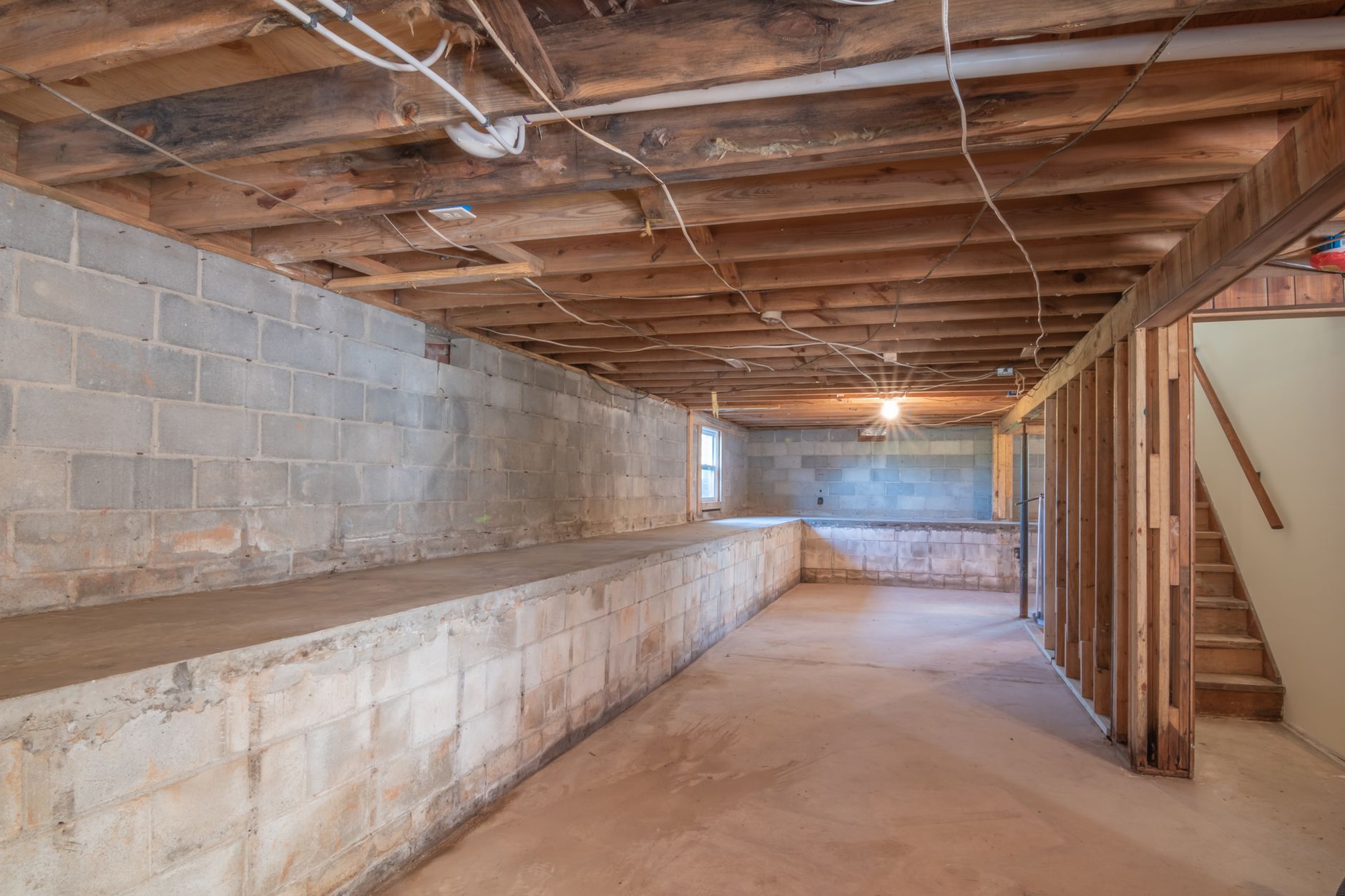
Below grade, moisture wins arguments that upstairs floors never have to have. Luxury vinyl plank and ceramic or porcelain tile are the two materials that consistently survive a Minnesota basement. Solid hardwood does not belong there at all, and carpet, laminate, and engineered wood all need conditions verified before they go in, not assumed.
Why do basements fail floors that work fine upstairs?
A basement floor sits on or near a concrete slab that is in direct contact with soil, and Minnesota soil holds groundwater for a long season. Moisture moves upward through concrete as vapor even when the slab looks and feels dry. Materials that depend on a stable, low-humidity subfloor — solid wood especially — expand, cup, or delaminate in that environment. Materials that do not care about moisture vapor, or that are built specifically to shed it, are the ones left standing.
Add to that the practical realities of a below-grade room: a sump pump that can fail, a floor drain that backs up occasionally, window wells that leak during a heavy rain, and a slab that is often colder than the rest of the house for months at a time. None of that is unique to old houses, but it is more common in them, because older basements were rarely built with today’s expectations for a finished living space.
Which materials actually hold up below grade?
Not every material on a showroom floor is a candidate for a basement, and treating them as interchangeable is where a basement project goes wrong before it starts.
Luxury vinyl plank
LVP is the material most often recommended for finished basements, and for good reason: it is a fully synthetic, waterproof product that does not swell or rot when it gets damp, and click-lock varieties can float over a concrete slab without full adhesive. Installed cost runs $2 to $12 per square foot depending on plank thickness, wear layer, and how much of the existing floor needs to come out first — that range is a planning figure, not a quote, and the reader’s own layout and prep work will set the final number.
LVP’s limits below grade are less about the material and more about what sits under it. A slab with an active moisture problem will still cause trouble at the seams and under the pad, even with a waterproof product on top. That is a testing question, not a flooring question.
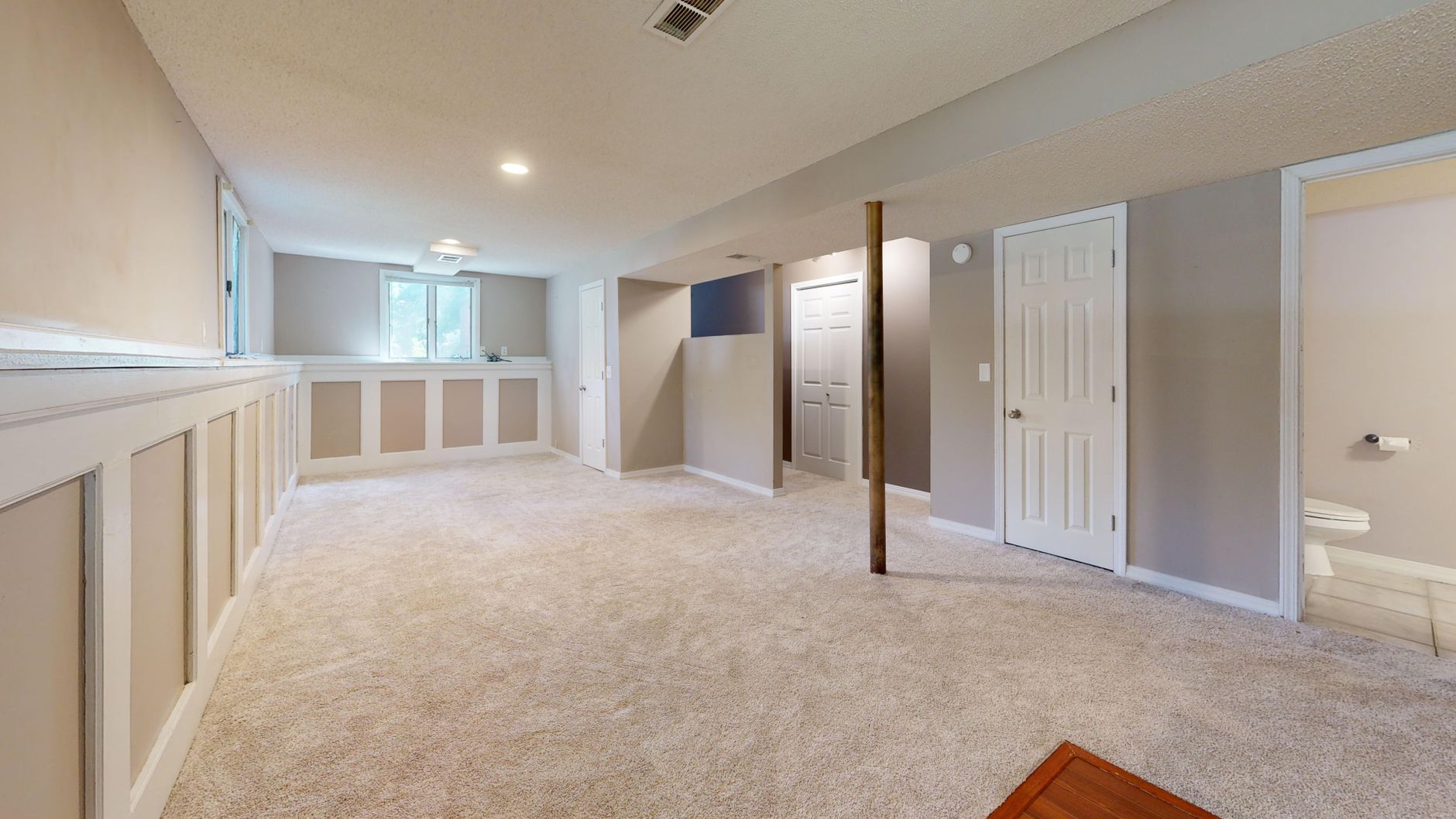
Ceramic and porcelain tile
Tile is the other material that genuinely belongs below grade. It does not absorb water, it tolerates a cold slab without complaint, and it is a common choice for basement bathrooms and mechanical-adjacent spaces where an occasional spill or condensation is a given. Installed tile runs $9 to $14 per square foot as a planning range; natural stone tile runs considerably higher, from $15 to $40 per square foot, and both figures depend on the reader’s own square footage, layout, and substrate condition rather than any fixed price.
Tile’s real limitation below grade is the floor system underneath it, not moisture. Rigid tile needs a subfloor that does not flex. A slab is rigid by nature, but if there is a plywood underlayment or sleeper system between the slab and the tile, that layer has to be stiff enough, or the grout lines crack.
Carpet, laminate, and engineered wood — conditional at best
Carpet is common in finished basements because it is inexpensive and comfortable underfoot, running $2 to $8 per square foot installed as a planning range. It is also the material most vulnerable to a moisture event: a wet carpet pad against a slab does not dry quickly, and mold risk follows. Carpet in a basement is a decision made with eyes open about what a sump pump failure or a spring thaw does to it.
Laminate, at $3 to $10 per square foot installed, has a fiberboard core that swells if it gets wet, which makes it a poor match for a room where dampness is even an occasional possibility. Engineered wood, priced within the same $6 to $21 hardwood installed range depending on product, tolerates more than solid hardwood because of its plywood-style core, but it is still a wood product with real moisture limits. Solid hardwood itself, refinishing aside, is not a basement material — it belongs on materials built for grade-level and upper floors, not below them.
What does a Minnesota basement slab actually give you to work with?
The condition of the concrete matters more in a basement project than in almost any other room in the house, and it varies enormously across Minnesota’s housing stock. The median Minnesota home was built in 1965, and a quarter of the state’s houses predate 1940 — a housing age distribution the U.S. Census Bureau’s American Community Survey confirms is among the oldest in the country. That range covers a huge span of basement construction methods.
A basement poured in the last two decades likely has a vapor barrier under the slab and drain tile around the footing. A basement under a house built before 1940 may have neither. Some pre-war Minnesota basements were built with fieldstone or rubble foundation walls and a thin slab poured on grade with no vapor barrier at all — a completely different starting point than a modern poured-and-sealed foundation, and one that changes which flooring choices are reasonable.
None of that is something a flooring choice fixes on its own. A slab’s moisture behavior is tested, not guessed at, and a contractor’s estimate for a basement job should include how they plan to check it before committing to a material.
What does it cost to floor a basement in Minnesota?
Cost in a basement is driven less by the material itself and more by what has to happen before it goes down. Removing an old floor — carpet, sheet vinyl, or a failed laminate — runs $1 to $4 per square foot, and that range assumes no unexpected subfloor damage underneath. A basement with a history of moisture problems can turn a straightforward removal into a longer job once the old flooring comes up and what is underneath it becomes visible.
Beyond removal and material, a basement project often needs its own line items: a moisture-mitigating underlayment, a sub-floor system that keeps flooring off the slab entirely, or leveling compound for an uneven pour. None of those show up in a per-square-foot material price, which is why a single number for “basement flooring cost” does not really exist. The Minnesota flooring cost estimator — actually located at the site’s cost estimator tool — is built to take those variables and return a range specific to a given basement rather than a statewide average, which is the more useful number for planning purposes.
For a broader look at what installed flooring costs across materials and across Minnesota’s different housing markets, the flooring cost hub lays out the ranges this site publishes and how they compare city to city.
Do older Minnesota basements need extra prep?
Often, yes — and the reasons are specific to how basements were built in different eras rather than to the house’s age alone. A basement under a home built in the 1920s or 1930s may have a slab poured directly on soil with no drain tile, no vapor barrier, and decades of small settling cracks that were never a problem when the floor was bare concrete or old sheet vinyl.
None of that rules out finishing the space. It does mean the standard advice — moisture test the slab, check for active water intrusion during a wet season, and confirm there is a way to get water out if the sump ever fails — matters more, not less, in an older foundation. Cities with the oldest housing stock in the state, including Minneapolis at a median build year of 1951 with 42.8% of homes pre-1940, and St. Paul at 1952 with 41.6% pre-1940, have a large share of basements built under very different assumptions than a house finished last decade in a newer suburb like Woodbury, where the median home dates to 1997 and only 1.3% predates 1940. The city-by-city housing stock hub breaks down those differences for the state’s nine largest markets.
Radon is a separate but related consideration in below-grade spaces, since flooring work that disturbs a slab or seals it more tightly can interact with a home’s radon mitigation. The EPA maintains guidance on testing and mitigation, and testing — not a flooring choice — is the way to answer that question for a specific house.
What about permits and licensing for basement flooring work?
Finishing a basement in Minnesota often triggers permitting beyond just the floor — egress windows, electrical, and framing for new walls are the parts of a basement finish most likely to need a local permit under the Uniform Construction Code. Permits in Minnesota are enforced at the municipal level, so the applicable rules and required inspections come from the reader’s own city or county building department, not from a statewide flooring rule.
Flooring installation itself carries a specific licensing exemption in Minnesota that is worth understanding before hiring anyone — a detail covered in full on this site’s page about the flooring installer licensing exemption. Verifying that a contractor is in good standing is a separate step from permitting, and the Minnesota Office of Attorney General maintains a public contractor registration lookup for exactly that purpose. More on hiring a contractor for a basement job, including what a written estimate should cover, is in the hiring and permits archive.
How do you keep a basement floor performing once it’s in?
A basement floor that survives installation still needs ongoing attention that upstairs floors mostly do not. Checking the sump pump before spring thaw, watching for condensation on cold slab edges in summer, and addressing any grout or seam separation quickly rather than waiting are the habits that keep a below-grade floor from becoming a repeat project. General upkeep and repair guidance across materials is collected in the care and repair archive.
Frequently asked questions
Is luxury vinyl plank actually waterproof in a basement?
The plank itself is a fully synthetic, waterproof product. What is not automatically waterproof is the seam and edge treatment, the underlayment, and the slab beneath it — a moisture problem in any of those layers can still cause trouble even with a waterproof plank on top.
Can solid hardwood ever go in a Minnesota basement?
Solid hardwood is not recommended below grade because of sustained humidity and moisture-vapor exposure from the slab. Engineered wood, with a plywood-style core, tolerates more variation, but it is still a wood product and carries real limits that LVP or tile do not.
Does a basement floor need a vapor barrier under it?
Many basement flooring systems, especially floating LVP, include a moisture-mitigating underlayment specifically because older Minnesota slabs were often poured without one. Whether a given basement needs additional vapor mitigation is a testing question for the specific slab, not a rule that applies to every basement equally.
Does finishing a basement floor require a permit?
Flooring installation alone is less likely to trigger a permit than the egress, electrical, or framing work that usually comes with finishing a basement as living space. Permit requirements are set and enforced locally, so the reader’s own city or county building department is the authority to check before starting.
MN Floors is an independent Minnesota flooring resource. We do not sell or install flooring, we do not quote jobs, and nobody from this site will call you. Cost figures here are published planning ranges for Minnesota, not quotes — what you actually pay depends on your rooms, your subfloor and the material you choose, and the final price depends on your project. Photography is licensed stock used to illustrate materials and rooms; it is not work by anyone connected to this site. Building code and permit requirements are enforced locally in Minnesota, so confirm anything regulatory with your own municipality before you rely on it.
Any prices mentioned are indicative only. Tool prices move constantly and vary by market, by retailer, and by whether a kit includes batteries or a charger — check the current price yourself before deciding.
Featured image: Photo by Curtis Adams via Pexels.